What is the difference between HR and Directories?
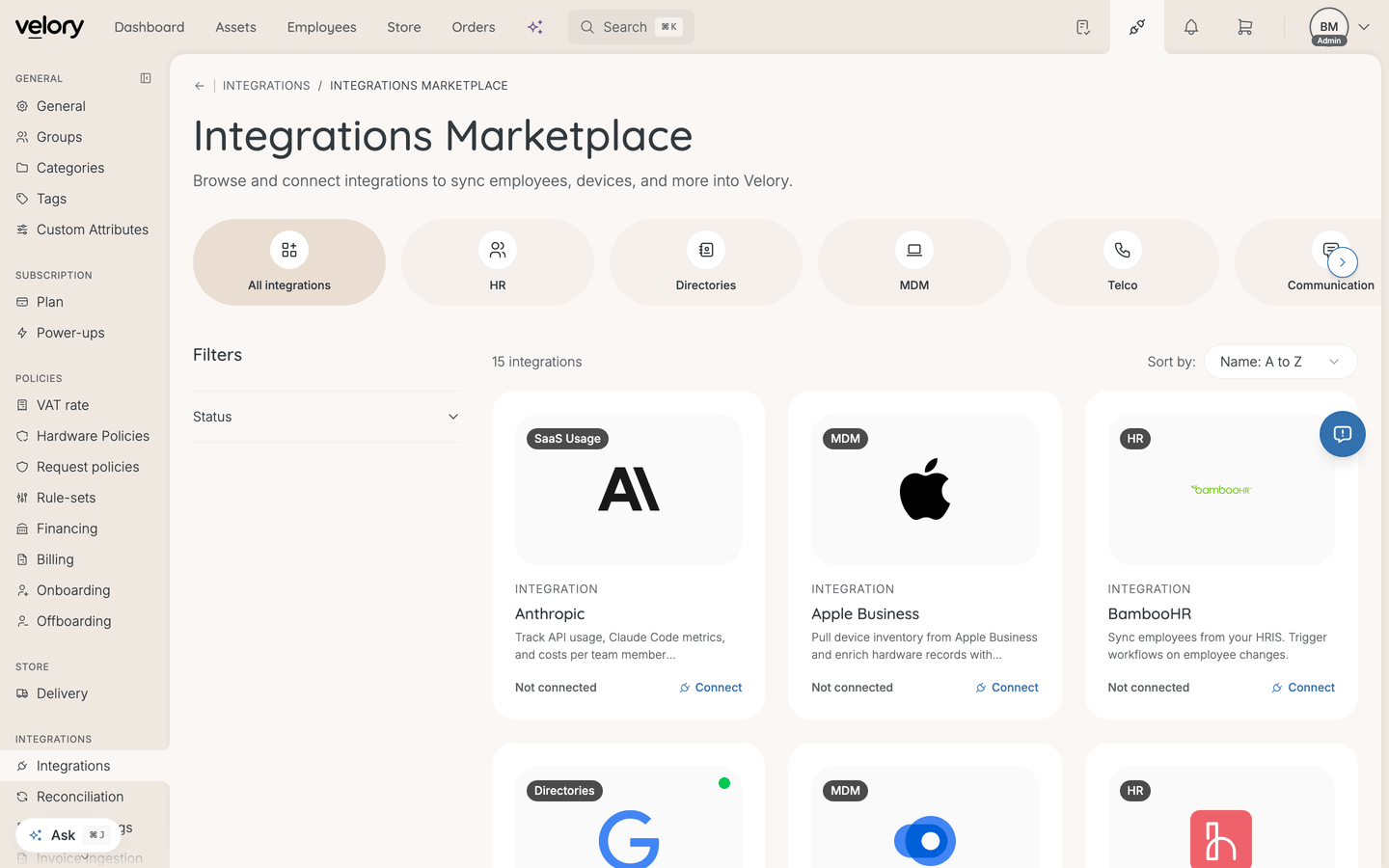
Both bring employees into Velory, and the marketplace lists them as separate categories. The difference is what kind of system you are reading from, not how the sync works.
- HR is your system of employment record — BambooHR, Hailey HR, HiBob. It knows who you have hired, their job title, their cost centre, and when they start and leave.
- Directories are your identity provider — Google Workspace, Microsoft Entra ID. They know who currently has an account and can log in.
In this guide
Side by side
| HR | Directories | |
|---|---|---|
| Providers | BambooHR, Hailey HR, HiBob | Google Workspace, Microsoft Entra ID |
| Answers | "Who works here?" | "Who can sign in?" |
| Knows about people | Before their accounts exist — including start dates | Once an account is created |
| Groups | Derived: one per department | Real directory groups, synced as they are |
| Connects with | OAuth or an API token, depending on the provider | An admin sign-in to that directory |
Underneath, they sync the same way
Apart from groups and scope, a directory syncs employees using the same machinery as an HR system: same reconciliation of imported people, same field mappings, same per-connection record links.
The how-to articles are still separate, because the steps you actually take differ — how you authenticate, and whether there is a scope to choose:
The marketplace keeps them separate for the same reason — an admin looking for Entra ID does not think to look under HR.
The one behavioural difference: groups
An HR system has no concept of groups, so Velory derives one group per department from it. A directory has real groups and syncs those.
You see this in the sync result and on the manual sync button: an HR connection reports departments, a directory connection reports groups. Same sync, different noun, because the source material genuinely differs.
Good to know
Which one should I connect?
Whichever is the better record of who works at your company.
If you only connect one, an HR system is usually the stronger employee source: it knows about people before their accounts exist, and it carries employment data a directory does not have.
Can I connect both?
Yes, and it is a common setup. Use the HR system as the employee source and the directory for groups and access.
When both provide the same field, field mappings decide which one wins — see How does HR syncing work?. Set those before your second sync, or you will be reviewing matches you did not need to.
Will connecting both create duplicate employees?
No, as long as reconciliation can match them. People are matched on email and other identifiers, and a high-confidence match is merged rather than duplicated. Anything ambiguous is queued for you to decide.
Does a directory replace my HR system in Velory?
No. Neither is authoritative by default — the primary source is per field, not per integration. The first integration you connect becomes the default primary source, and you change that in field mappings.
Was this article helpful?